Wednesday, November 02, 2022

Where Could This War Go?

For those with the time, this discussion of the outlook for the war in Ukraine is very informative. The first 50 seconds or so is just an outtake from later in the discussion; i.e., it repeats itself. The whole thing is about 18 minutes.

Where else have Iranian drones been used by one side, and Turkish drones by the other?  It could be significant down the road.

What NATO country is most likely to wimp out this winter? His guess is the same as ours.


Sunday, October 30, 2022

On the Other Hand ...

A week ago we heard retired U.S. General Ben Hodges predict that Ukraine would take back Crimea next year.  Wow! That's great news. 

It is not an opinion held by all. In this video, former MI6 chief Alex Younger is not so optimistic. The entire interview is interesting and informative, but his opinion about the course of the war begins at about 8:50.


Wednesday, October 26, 2022

Ocean Conservation Namibia

Could you use a pick-me-up video? Give this one a try.

A small organization called Ocean Conservation Namibia is in the seal rescue business, if you can call it a business. On the coast of that southwest African nation, seals by the hundreds become entangled with fishing lines, fishing nets, gill nets, Coca-Cola cans, hard hat head bands – whatever is thrown in the ocean – in astounding numbers. In time, the entangled lines cut into the animals' necks, causing horrible wounds. These guys patrol the beaches and the docks looking for seals in such danger, capturing them, removing the entanglement, and setting them free.

What a great job!


Tuesday, October 18, 2022

What's Happening in Utah?


Sen. Mike Lee with his ventriloquist
You've probably read that Senator Mike Lee of Utah looks to be in trouble. Polls are showing him neck-and-neck with his Independent challenger, Evan McMullan. An article by A.B. Stoddard in The Bulwark explains how that came to be:

Over the last six years, Donald Trump has ruined many Republican political careers. Lee is now scrambling to avoid becoming another of them. The two-term senator knows exactly why his campaign is in trouble and what led to his humiliation on Fox News [i.e., when Lee almost begged Mitt Romney for his endorsement, which Romney has withheld].

Lee isn’t in trouble because of (just) Democratic voters. His re-election is teetering because of Republican voters who are disgusted by his full embrace of Trump—including his attempts to help Trump overturn the 2020 election. These machinations created space for former CIA officer Evan McMullin to run as an independent after convincing the Utah Democratic Party not to put anyone on the ballot this year. McMullin has, improbably, energized a coalition of moderate Republicans, unaffiliated voters, and Democrats behind his candidacy. Mitt Romney has chosen not to endorse either candidate, saying they are both friends.

Maybe we've been too hard on Romney.

Monday, October 17, 2022

The Kalinouski Regiment

Nearly every day the evidence mounts that Putin's invasion of Ukraine was a blunder of breathtaking proportions. Case in point: The Kalinouski Regiment.

In the October issue of The Atlantic, Anne Applebaum writes about the Kalinouski Regiment, a military unit made up of Belarusian volunteers, formed in March to help defend Ukraine from the Russian invaders. The New York Times puts the current size of the growing regiment at nearly 500 troops. Members of the regiment oppose the Lukashenko regime in Belarus. They joined the Kalinouski Regiment to help Ukraine and receive NATO military training, with an eye to the long term goal of removing Lukashenko.

Belarus was a component of the USSR until it declared its independence in 1994, after the communist giant fell apart. In its first and only free and fair election, Belarus elected Alexander Lukashenko president. Lukashenko immediately began closing down the pillars of democracy in the country: free speech, free press, opposition parties, and free and fair elections. Nevertheless, Lukashenko's control of the country has always been tenuous, and he has depended on Russia, and Putin in particular, to help suppress his opposition and keep him in power. Most recently, he received Russian assistance to quell demonstrations throughout the country following his "victory" in the country's fraudulent 2020 elections.

  
Belarus

Belarus shares a 674 mile border with Ukraine on the south, and at its closest is less than 65 miles away from Kiev. The Russian attack on Kiev in February originated from Belarusian soil, though it did not include Belarusian soldiers. Lately Putin has been leaning on Lukashenko to commit huge numbers of troops to help rescue Russia's failing invasion, and Belarusian troops have been deployed in the last week to the Ukraine border, where they are reportedly organizing with Russian troops. 

But, though Putin may demand it, you can be sure that sending Belarusian troops into Ukraine is the last thing Lukashenko wants.  His hold on power is too tenuous. The absence of a large part of his army from the country, fighting in an increasingly unpopular war, will leave his regime exposed, and Russia is not in a good position to come to his aid, as it did in 2020.  And, long-term, he certainly sees that Belarus is on Putin's to-do list as the Russian president goes about his reconstruction of the Russian Empire of Peter the Great. 

The Kalinouski Regiment hopes to have something to say about that.

Thursday, October 13, 2022

The Party of Lincoln 😢

Yesterday Arkansas Senator Tom Cotton (last seen running for his life from the January 6 insurrection he had urged on) and Florida Senator Rick Scott (best known for his leadership of Columbia Hospital Corporation while it defrauded Medicare and Medicaid, for which it was fined $1.7 billion) joined Herschel Walker (who helped Georgia beat Notre Dame in the 1981 Sugar Bowl) on the campaign trail.

They got their just desserts:


A Surprising Prediction

Retired General Ben Hodges was once the commanding general of United States Army Europe, so he brings a wealth of relevant background to this survey of the Ukraine battlefield, and its prospects for the next year.

We think his discussion (below) is worth the 12 minutes of your time. [Spoiler alert: He expects Ukraine will have recovered Crimea by Summer 2023.]


Sunday, October 09, 2022

Putin's Russian Empire is Slip-Sliding Away

The New York Times has an important front-page article today, A Distracted Russia is Losing Its Grip on Its Old Soviet Sphere. Last week we were writing about how Russia's preoccupation with Ukraine was leaving the Central Asian nations up for grabs, and how China is moving in. You may fairly ask, "What has this got to do with me?" Today it doesn't. Tomorrow we may wish we hadn't been so myopic about the countries with funny names.


In case you don't have a subscription to the Times, here are some tantalizing morsels that might make you consider at least the online edition:

 With the Kremlin distracted by its flagging war more than 1,500 miles away in Ukraine, Russia's dominium (sic) over its old Soviet empire shows signs of unraveling. Moscow has lost its aura and its grip, creating a disorderly vacuum that previously obedient former Soviet satraps, as well as China, or moving to fill.

...Today, Armenia is fuming. Its prime minister, Nikol Pashinyan, who has been a close ally, appealed to Moscow in vain last month for help to halt renewed attacks by Azerbaijan. Furious at Russia’s inaction, Armenia is now threatening to leave Moscow’s military alliance, the Collective Security Treaty Organization.

The Kazakh government that Mr. Putin helped prop up in January is veering far from the Kremlin’s script over Ukraine, and is looking to China for help in securing its own territory, parts of which are inhabited largely by ethnic Russians, and which Russian nationalists view as belonging to Russia.

And here along the mountainous border between Kyrgyzstan and Tajikistan, long-running quarrels between farmers over land, water and smuggled contraband escalated last month into a full-scale conflict involving tanks, helicopters and rockets, as the armies of the two countries fought each other to a standstill.

...Moscow’s security alliance has long been touted by Mr. Putin as Russia’s answer to NATO and an anchor of its role as the dominant (and often domineering) force across vast expanses of the former Soviet Union. But now the bloc is barely functioning. Five of its six members — Armenia, Belarus, Russia, Tajikistan and Kyrgyzstan — have been involved in wars this year, while the sixth, Kazakhstan, has seen violent internal strife.

...Some officials in [the Kyrgyzstan capital of] Bishkek wonder if Russia winked at the military action by Tajikistan, a tightly controlled dictatorship ruled by the same leader since 1994, even longer than Mr. Putin has been in control of the Kremlin. Kyrgyzstan, by contrast, is considered the only Central Asian country with a modicum of real democracy and a relatively free press.

The view of Mr. Putin siding with Tajikistan — rather than being an unbiased umpire between two members of his military alliance — gained more ground this past week when the Kremlin declared that it was giving the veteran Tajik dictator, Emomali Rahmon, a prestigious state award for his contribution to “regional stability and security.”

Kyrgyzstan’s foreign ministry said the award, announced by Moscow “while the blood of innocent victims has not yet cooled on Kyrgyz soil,” had caused “bewilderment.”

Read the whole article

Putin is trying, step-by-step, to reconstitute the Russian Empire of Peter the Great. But his obsession with Ukraine is leading to neglect of the rest. He's a murderous tyrant, to be sure. But apparently he can't walk and chew gum.


Thursday, October 06, 2022

The Useful Idiots

William Saletan at The Bulwark has been watching Fox "News" so we don't have to. Today he reports that while the daytime programming is presenting accurate information about the Russian invasion of Ukraine, the demimondaines of the Fox evening hours apparently aren't watching. It's too early to call them a fifth column, but ....

Read Saletan's article here.

A sample:

“Putin is making nuclear threats,” [Tucker Carlson] noted. “Whatever the reason he is making them, the fact he is making them . . . is enough for any responsible person to say, ‘Now we stop.’”

Really? We want to make it that easy for Putin?

The Bulwark, by the way, is a web site founded by conservative Republicans (specifically, Sarah Longwell, Charlie Sykes and Bill Kristol) whose loyalty to facts and truth is greater than their loyalty to the Republican Party. Thus, former Republicans.

Thursday, September 22, 2022

Make a New Plan, -stan

While our attention is focused on the war in Ukraine, other things are happening which may not be below the radar, but the significance of which might easily be missed.

This interview with Scott Lucas, founder and editor of EA Worldview and a professor at the University of Birmingham, caught our attention. The larger point he makes is that China is opportunistic, and is as happy to cash in on Russia's failures as it would have been on Russian success. Case in point: Kazakhstan. The really interesting stuff starts at about 1:57 minutes into the video.


 Now, we may wonder why we (or China) should be interested in Kazakhstan. There was certainly a time when we could (and did) ignore Kazakhstan. But consider the map:


It borders China. It borders Russia. It is on the Caspian Sea; so is Iran. Its western end is in Europe!

According to Wikipedia:

Kazakhstan has an abundant supply of accessible mineral and fossil fuel resources. Development of petroleum, natural gas, and mineral extractions has attracted most of the over $40 billion in foreign investment in Kazakhstan since 1993 and accounts for some 57% of the nation's industrial output (or approximately 13% of gross domestic product). According to some estimates,[48] Kazakhstan has the second largest uranium, chromium, lead, and zinc reserves; the third largest manganese reserves; the fifth largest copper reserves; and ranks in the top ten for coal, iron, and gold. It is also an exporter of diamonds. Perhaps most significant for economic development, Kazakhstan also has the 11th largest proven reserves of both petroleum and natural gas.

All very boring.  But the Chinese are paying attention.
 

Monday, September 19, 2022

Monday, September 12, 2022

Some Russians,, at Last, Are Coming to Their Senses

There's nothing I can add to the news reports of the Russian Army's collapse in the Kharkiv region, but maybe you haven't seen this, a panel discussion on Russian television that could be titled, "Where do we go from here?":

https://twitter.com/JuliaDavisNews/status/1569070513909022720

You'll need to at least have a Twitter account to watch it, unfortunately. 

Incidentally, found this video in an excellent article in The Bulwark. If you're interested in the subject, I highly recommend it.

Saturday, August 06, 2022

What Works in Kansas

Back in 2004, Thomas Frank's book, What's the Matter with Kansas?, was all the rage among liberals. One theme of the book was that Kansans tended to vote in ways that were not in their own best interests. The implication of the title was that it was their fault. Maybe it was.

 So when Kansans recently voted overwhelmingly to block an amendment to the state constitution that would allow banning all abortions, it was a shock still reverberating around the talk shows.

This article from the Washington Monthly tells how the local campaigners against the amendment chose to speak to voters in the context of the voters' own value systems, rather than that of the bi-coastal progressives. It worked. The article has links to the television ads they ran, which are very instructive. If you do nothing else with this, at least watch the ads.

After decades of scorning and neglecting "fly-over country", hopefully the Democratic Party can actually learn a lesson from this. It's very slow learning curve so far has resulted in the Supreme Court we have now.

Monday, April 11, 2022

The Battle Ahead

"The battle for Donbas will remind you of the Second World War," according to Dmytro Kuleba, Ukraine's foreign minister, quoted in Financial Times.

Ukrainian troops are dug in with a network of trenches that is reminiscent of World War I.

The NY Times reports:

Analysts predict Russian troops, refocusing on the east after being thwarted in the capital, will carry out a major offensive stretching from Dnipro to Izium, a city almost 150 miles northeast [sic; it's NNW of Dnipro] where fighting has already been heavy, U.S. officials said Sunday. Satellite images showed hundreds of military vehicles moving through the town of Velykyi Burluk toward Izium on Friday.

This area is mostly flat, open land, and will not be conducive to the guerilla tactics that served the Ukrainians so well around Kiev. The sooner they get enormous supplies of heavy equipment, the better.

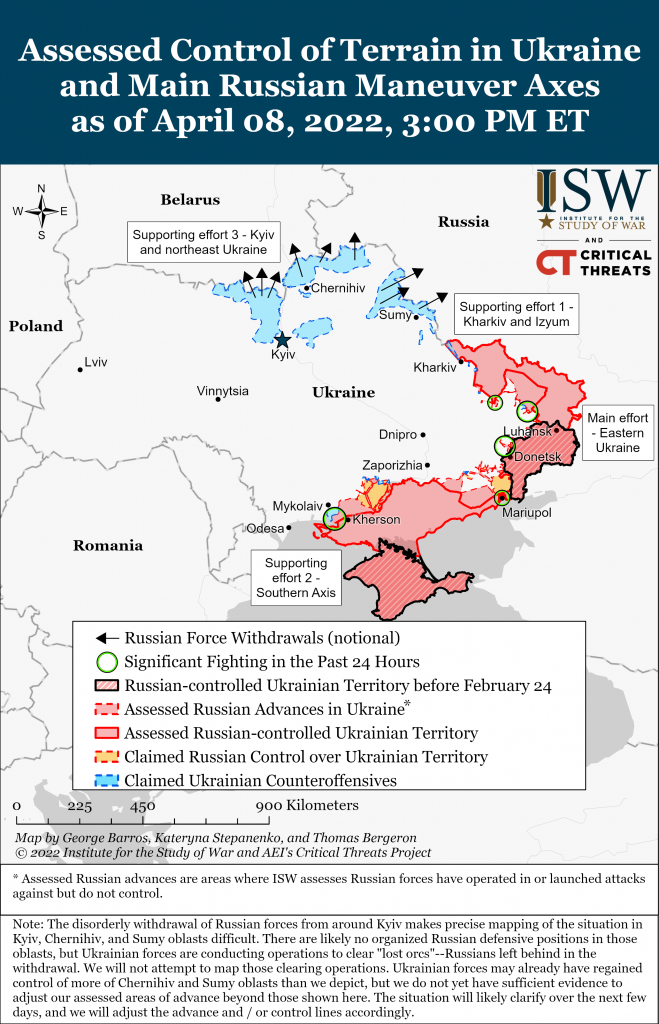
Two maps that tell the story:

Source: Institute for the Study of War

Source: The New York Times

Click on the maps for a larger view.

Saturday, April 09, 2022

The Russian Invasion

Here's something that caught my eye:

From the Financial Times:

A difference of 3mm encapsulates the challenges the west faces as it works out how to supply the weapons that Ukraine needs to hold off, or even repel, Russian forces during the next phase of the war: the looming battle for the Donbas. 

The list of weapons that Ukraine wants includes more long-range artillery to target the Russian positions that have been shelling its cities during six weeks of heavy fighting. However, most Nato countries’ heavy artillery has a 155mm calibre while Ukraine, as part of its Soviet legacy, uses 152mm. 

 “The Ukrainians are running out of 152mm ammunition. Where are they going to get it?” asked Chris Donnelly, an adviser to four former Nato secretaries-general on the Soviet and Russian military. “No one in the west uses it or makes it apart from the Serbs — and they’re on Russia’s side.” 

Looking for more detailed accounts of the military action in Ukraine than you can find in the New York Times or Washington Post?  The best I've found so far (and it's plenty for me) is Critical Threats, a website of the Institute for the Study of War. Critical Threats offers reliable reports and assessments of military activity in Ukraine. It is often used as a source by the Financial Times and the newspapers above.

The map below is from Critical Threats.


Friday, April 08, 2022

Timidity?

Back on March 15 we fully expected MiG fighter planes to be delivered to Ukraine for their use in providing air cover. But despite an offer by Poland to furnish the planes, they have not been delivered – apparently from fear that providing the planes, rather than the complications of delivering them, would involve NATO in the fighting.

Which is something I don't really understand.

During World War II, America provided military planes to Great Britain while we were still a neutral country.

In fact, the United States sent tanks to Russia while we were still a neutral country.

We should point this out as the planes and tanks cross the border into Ukraine.


Sunday, March 20, 2022

Brainstorming Russian Reparations

I'd like to spend a little more time thinking about the proposal, discussed in my March 18 post, that we use Russia's money to rebuild Ukraine. The first mention I saw of this idea is in Robert E. Litan's article at the Brookings Institute website. By Litan's reckoning, Western countries and Japan are holding about $350 billion of Russia's foreign policy reserves; these reserves are currently "frozen" by the sanctions placed on Russia. The fact that the reserves are called "frozen" and not "seized" implies they will be "unfrozen" some day – presumably when Russian troops are withdrawn from Ukraine.

This chart from Statista illustrates the distribution of the reserves.

Source: Statista.com
 Litan wrote "the fact that many countries already have control over Russia's holdings of foreign currency means that, in effect, reparations for the Ukrainian invasion have been pre-funded by Russia itself." Moreover, "there is a basis in international law for enabling nations that hold these reserves to commit them to pay for damages."

Russia has committed on a massive scale what under U.S. law is considered an “intentional tort”: unprovoked violence, which requires at a minimum that the aggressor pay damages for human suffering, deaths, and property losses. In December 2005 the United Nations General Assembly adopted a resolution affirming a variation of intentional tort doctrine by providing a right to reparations to victims of human rights abuses under international law.

The U.N. resolution is not self-enforcing, however. Instead, it charges member states to establish “national programs for reparation and other assistance to victims in the event that the parties liable for the harm suffered are unable or unwilling to meet their obligations.” It’s a safe bet that Russia won’t be willing to meet these obligations, so other countries now holding Russian reserves can best enforce the reparations principle by agreeing on a common plan.

Litan's Brookings article was originally published at Bloomberg.

There are several things to recommend this approach:

  • Turning all the frozen reserves back to Russia would mean that it gets to walk away from the damage it has done.
  • Russia's failure to help rebuild Ukraine means it would be entirely on the hands of, and dependent upon the generosity of, other countries.
  • The reserves can be used right now to provide help to Poland, Hungary, Slovakia, Romania, and Moldova, the nations that have generously welcomed 3 million Ukrainian refugees. They simply can't afford to do this forever, however, and who better to pay for it than Russia?
  • Perhaps knowing that every school, hospital, and apartment building destroyed by a Russian bomb or missile will be replaced using Russia's own money might incentivize Putin to reconsider further aggressive activities and negotiate a withdrawal as soon as possible, to cut his loses.

But there are arguments against confiscating and using Russian reserves in this way:  

  • Instead of making Putin anxious to conclude his invasion, the action might frustrate, humiliate, and infuriate Putin to the point that he takes a spiteful action that requires a NATO response.
  • There is that old law of unintended consequences. We must ask ourselves how unsettling actual confiscation, as opposed to "freezing," will be to the world financial system. It is beyond my ability to even imagine.

There may be a way to use the threat of reserves confiscation without actually taking the action. Let's say an American congressman introduces a resolution in the House that the reserves should be seized for refugees and reparations. A resolution is not a law, and the State Department and our allies would be under no obligation to do it. But a resolution might get Putin's attention, and encourage him to get ahead of things by working harder at negotiations.

Friday, March 18, 2022

Alright, Who's Gonna Pay for This?

A common analysis of the Ukraine War is that Putin overestimated the ability of his military to cow the Ukrainians into submission, and as a consequence a humiliated and enraged Putin has decided that what he can't have, he'll raze to the ground. Then, when he is able, he will install a puppet government, declare victory, and withdraw most of his troops.

That's a pretty bleak scenario, to be sure. Maybe he realizes he will never be able to set up a sham government, and will withdraw once the country is reduced to cinders. No less bleak.

Mariupol Theatre
Mariupol Theatre (Daily Beast)

At the Brookings Institute, economist Robert E. Litan suggests a way to help Ukraine rebuild: use Russian money.

According to the most recent data supplied by Russia’s central bank as of June 30, 2021, Russia’s foreign currency reserves totaled $585 billion, though not all of this would be accessible to pay for damages. That’s because Russia holds a good portion of the total in gold at home (22%), a substantial amount of renminbi in China (14%), and some in international institutions (5%). Subtracting these amounts leaves about $350 billion in “available reserves” for distribution—mostly held by France (12%), Germany (10%), Japan (10%) and the U.S. (7%), with the rest scattered among many other countries.

In the past, reparations have been paid after hostilities ended by the aggressor country—that was Germany in the first two world wars. Now, the fact that many countries already have control over Russia’s holdings of foreign currency means that, in effect, reparations for the Ukrainian invasion have been pre-funded by Russia itself. This is an admittedly unique circumstance, but there is a basis in international law for enabling nations that hold these reserves to commit them to pay for damages.

Okay, the first thing we need to say is, "Watch out for the law of unintended consequences." But it's an interesting idea, and there's an added appeal: If Team USA/Europe announces this plan beforehand, it could very well make Putin reconsider the wisdom of his scorched earth strategy. The less he destroys, and the sooner he gets out, the less he has to pay.


Tuesday, March 15, 2022

When Will the Lesson Be Learned?

In our dining room there is a bust of Winston Churchill, a family heirloom. My father was an admirer of Churchill. My (French, maternal) grandmother was not. I'm not sure why, but my theory is that it was related to her feelings about Mers-el-Kébir.

My grandmother lived with us for several months each year. When she was there, she and Dad engaged in a silent war. He would find the Churchill bust turned to face the back of the breakfront. He would turn it around to face the front again, only to find the next day that it had been turned around again. This went on for years, I think.

Winston was a very controversial figure before he led Great Britain's survival in World War II, and remained controversial in many quarters afterward. There is much to admire in the man, and much not to. He was a man.

There is a danger in using the "lessons of history" to guide our current actions. Too often we learn the wrong lesson, or apply it poorly. For example, how many times did Neville Chamberlain and Munich get mentioned as justification for the war in Vietnam. [Okay, one or two readers might be too young to remember, so I'll tell you: they were mentioned a lot!] If you put the wrong grid on a problem, you're likely to come up with the wrong answer. We lost that war, yet today Americans who served in it take their families there on vacation trips. As Kurt Vonnegut would say, "So it goes."

By the way, the movie, Munich: The Edge of War, does a fine job of telling the story from Chamberlain's point of view; a point of view that was shared by the British public (dramatic pause here) until it wasn't. Munich: The Edge of War is available on Netflix.

So back to Churchill.

Last week I mentioned Darkest Hour, also available on Netflix, a movie about the critical month of May 1940, when Churchill became Prime Minister. The British mood had changed from Hitler avoidance to Hitler confrontation. Still, Chamberlain and Lord Halifax counseled negotiation.
 
Here's a climactic scene from the movie (2 minutes):


I remembered this scene when reading Fareed Zakaria's March 10 column in the Washington Post, which concluded:

The greatest strategic opportunity lies with Europe, which could use this challenge to stop being the passive international actor it has been for decades. We now see signs that the Europeans are ready to end the era of free security by raising defense spending and securing NATO’s eastern border. Germany’s remarkable turnaround is a start. If Europe becomes a strategic player on the world stage, that could be the biggest geopolitical shift to emerge from this war. A United States joined by a focused and unified Europe would be a super-alliance in support of liberal values.

But for the West to become newly united and powerful, there is one essential condition: It must succeed in Ukraine. That is why the urgent necessity of the moment is to do what it takes — bearing costs and risks — to ensure that Putin does not prevail.

The emphasis is mine.